

PostgreSQL
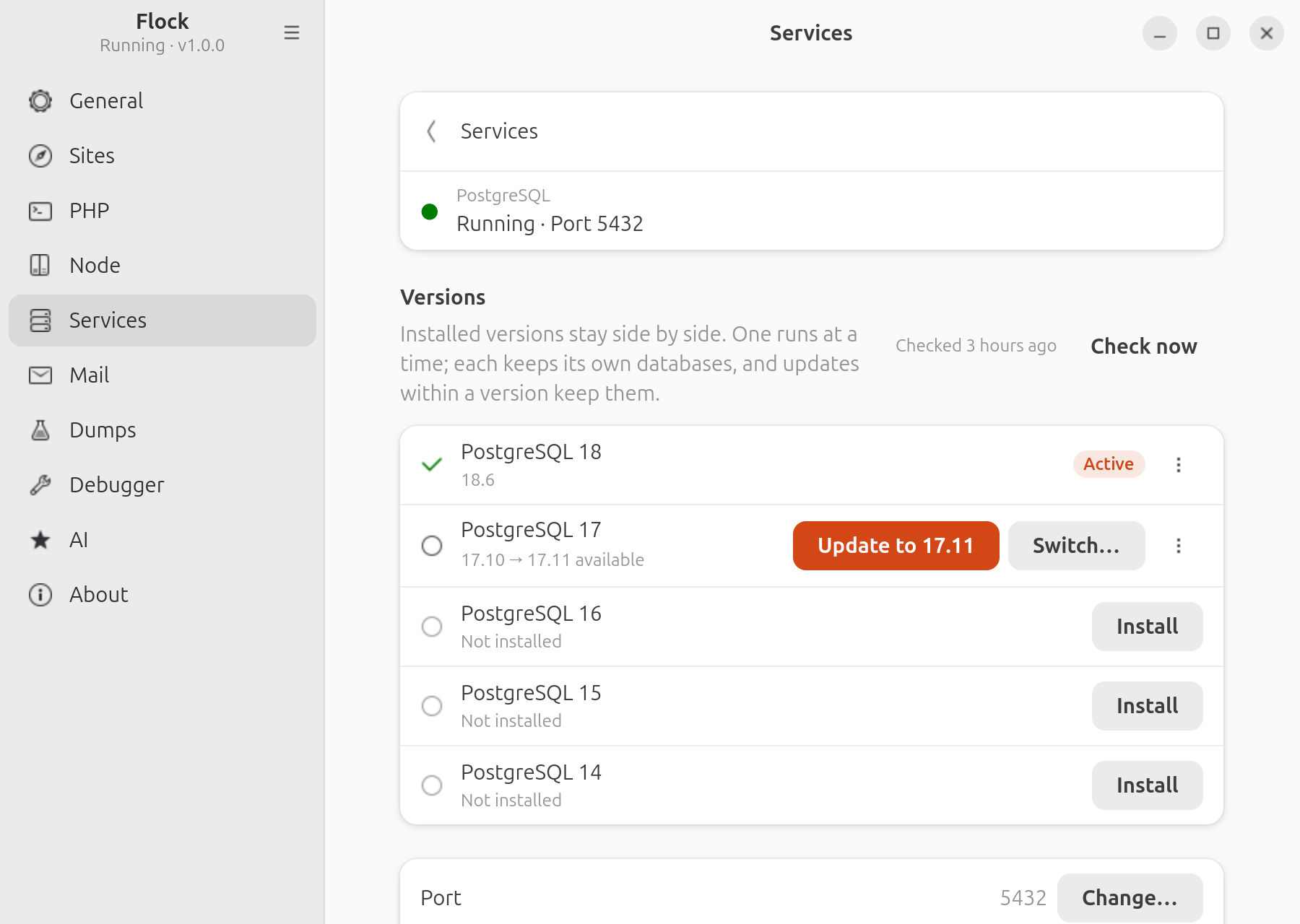
Flock runs PostgreSQL natively, from builds made for Flock. You can install several major versions, each with its own databases, and switch which one is active.
Installing
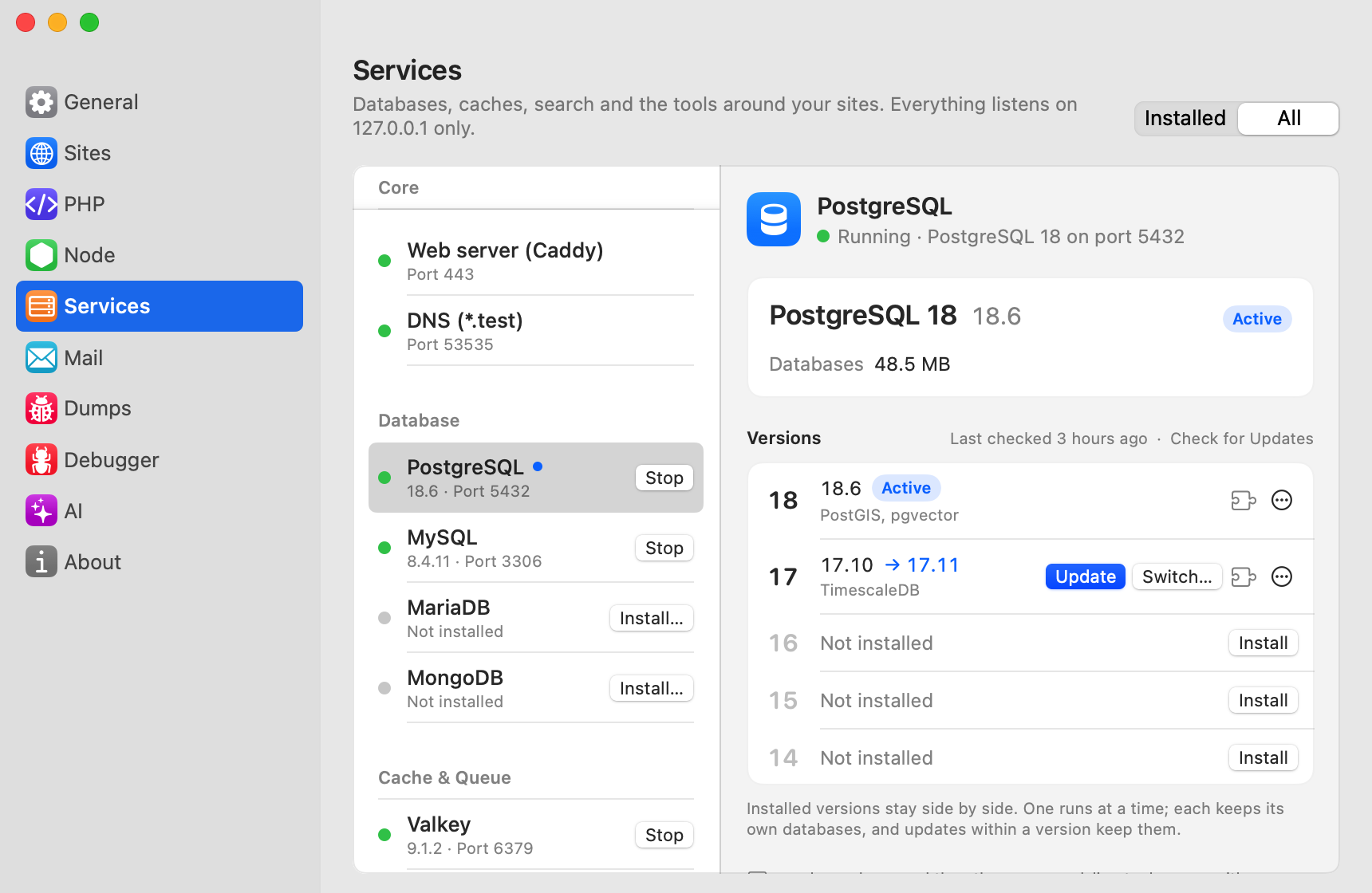
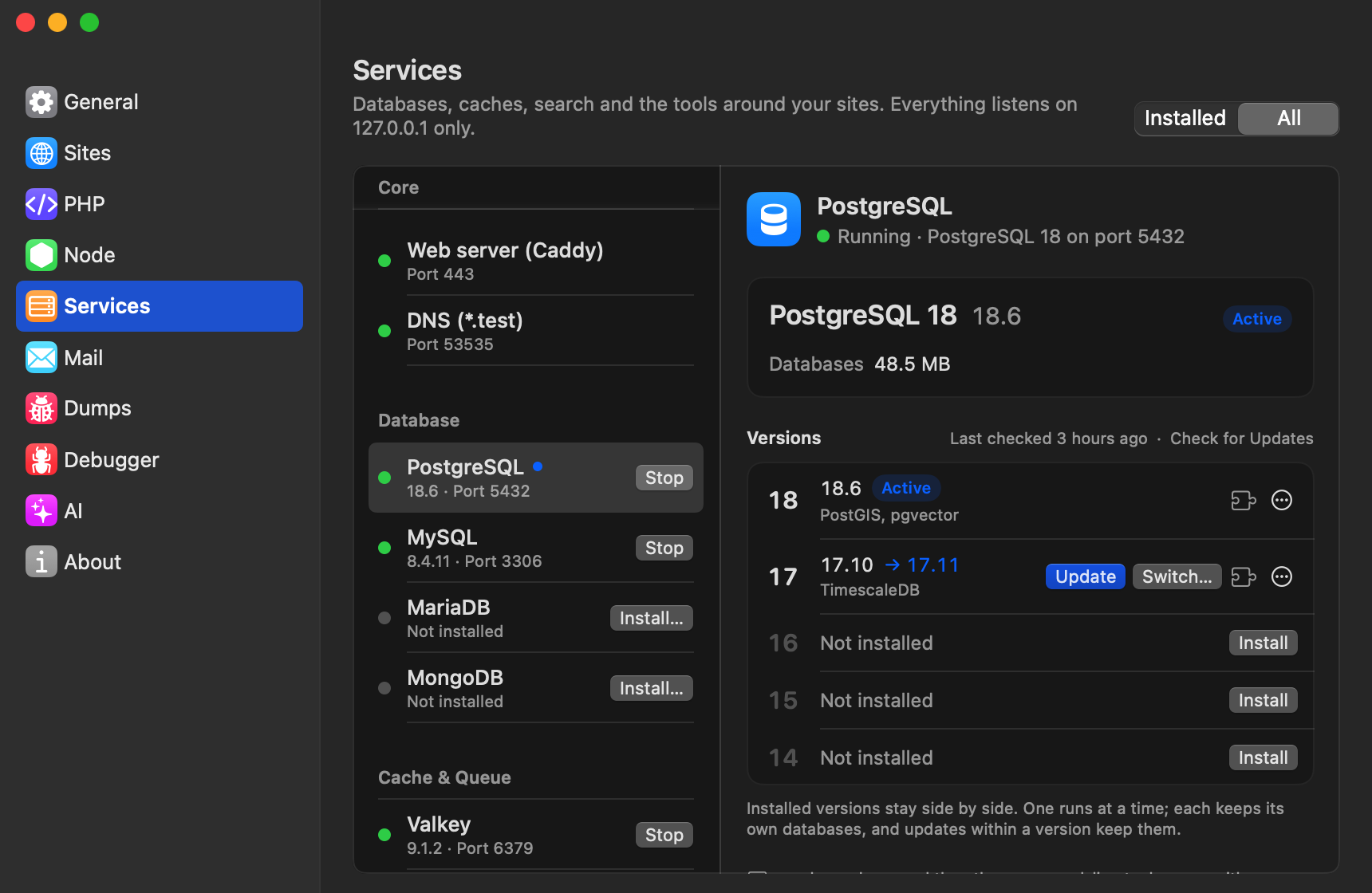
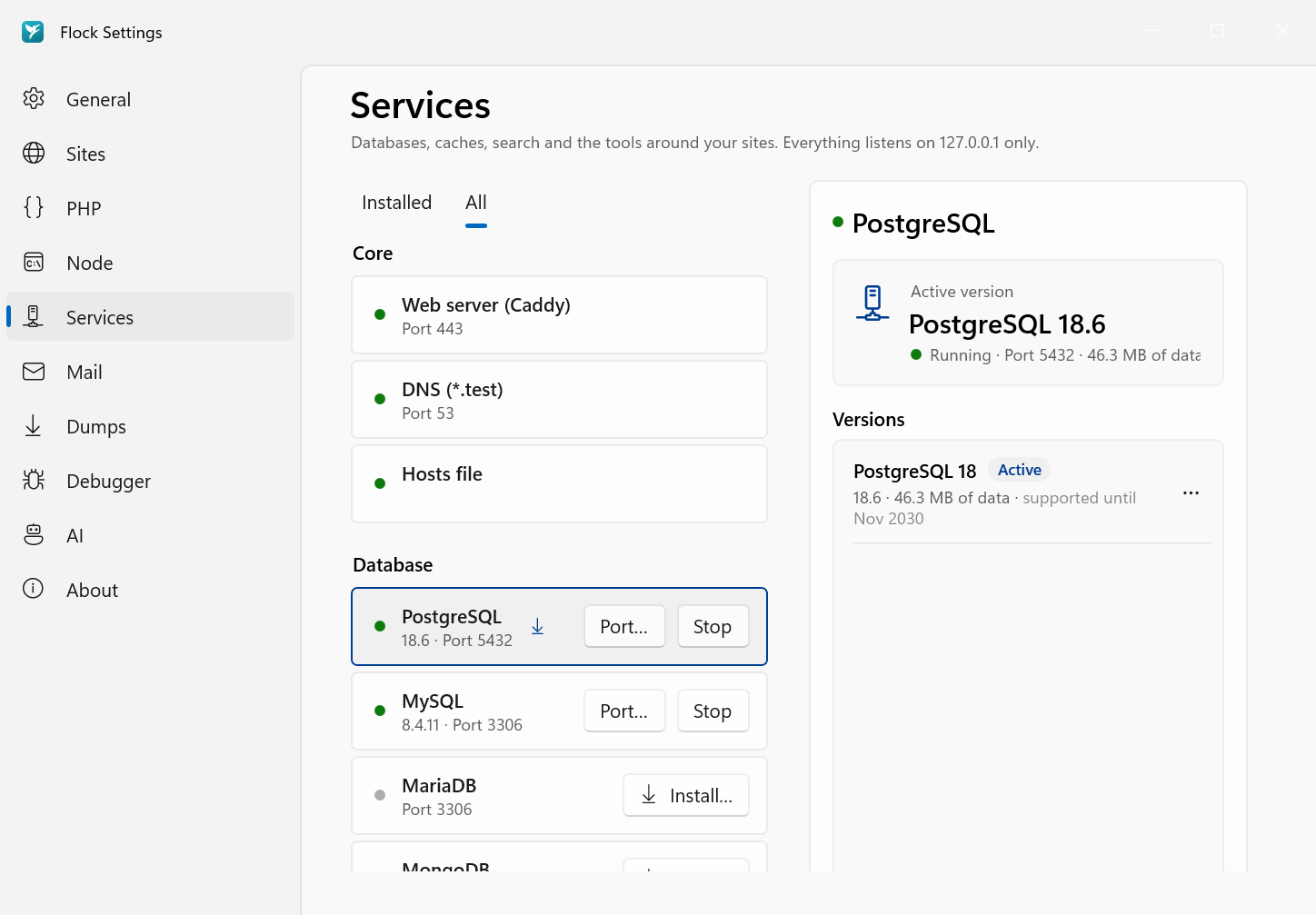
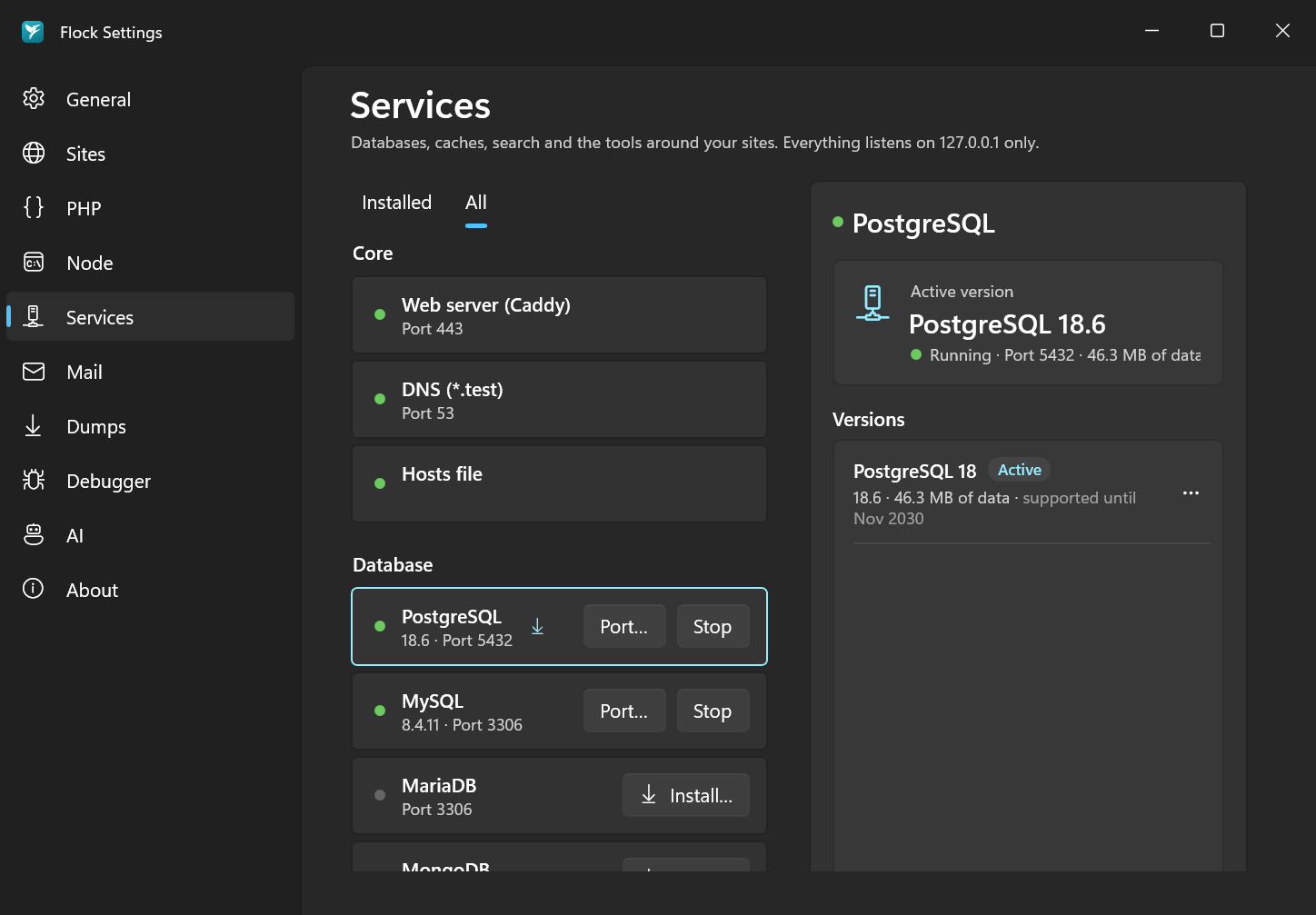
Open Settings… from the Flock panel, go to Services, switch the filter to All and select PostgreSQL. Pick a Version (the newest is preselected) and a Port, then click Install PostgreSQL 18.x (the button shows the exact release).
flock services install postgres        # PostgreSQL 18
flock services install postgres 16     # a specific major
flock services list postgres
PostgreSQL listens on 127.0.0.1:5432 as user postgres, without a password.
DB_CONNECTION=pgsql
DB_HOST=127.0.0.1
DB_PORT=5432
DB_DATABASE=laravel
DB_USERNAME=postgres
DB_PASSWORD=
Creating databases
Creating a database isn't in the app yet. Use the CLI command below, your database client, or let php artisan migrate create the database when it asks.
flock services create-db postgres acme acme_testing
PostgreSQL has to be installed and running.
Switching versions
Only one major version runs at a time. Each version keeps its own data directory, so switching back brings back your databases. Installing another major doesn't switch to it, and when you uninstall the active one, the newest other installed major takes over.
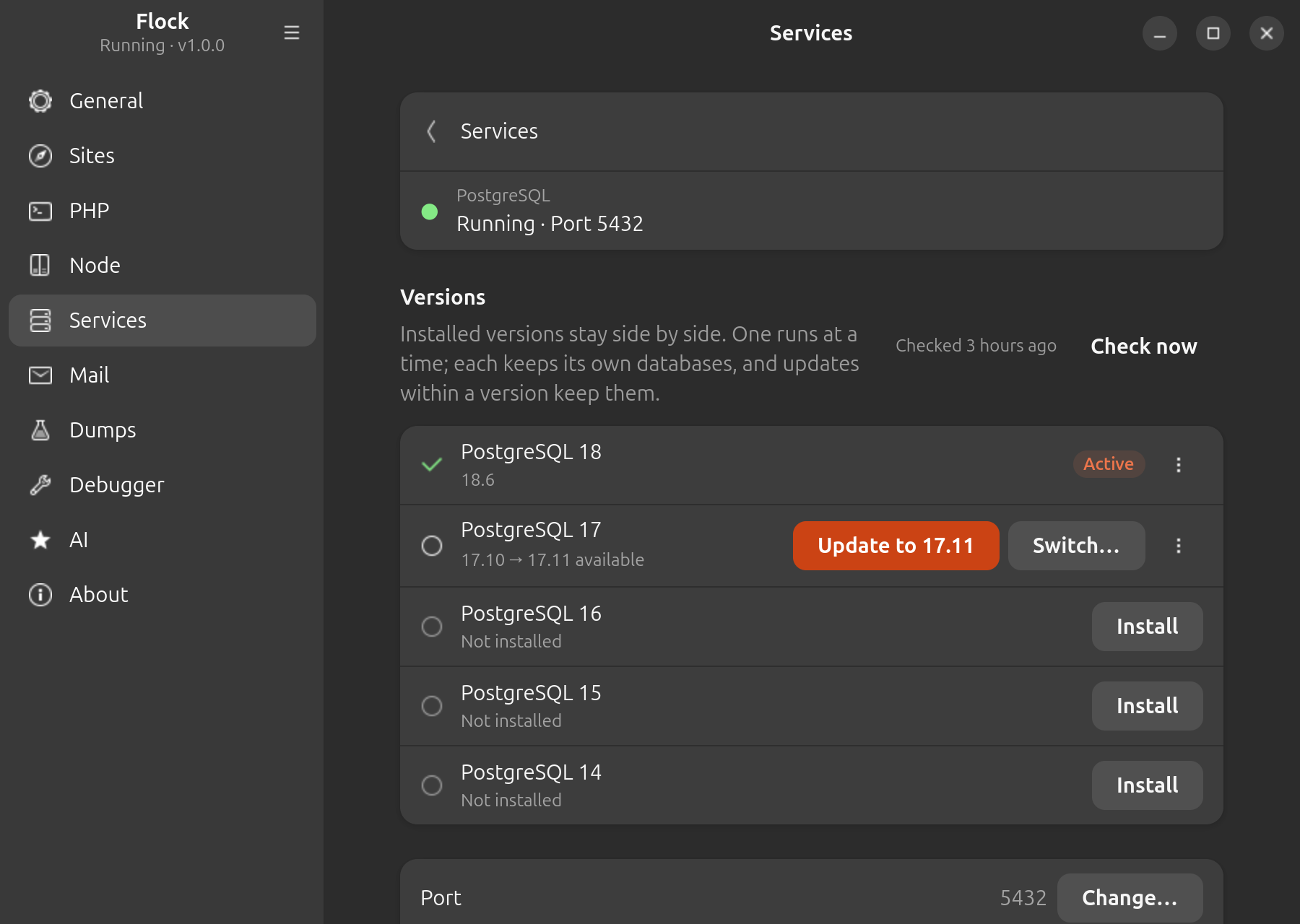
In the PostgreSQL detail, open More next to the version you want, click Switch…, and confirm with Switch. The card at the top shows the Active version and the size of its databases.
flock services use postgres 17
Updating and removing
Click Update next to a version to get its newest minor release (or a new build of the one you have), and Check for Updates to look for new ones. When several installed majors have updates, choose Install all updates (N) and confirm the listed majors and versions; Flock updates them one at a time and stops on the first failure.
On macOS, the active version's update is the Update button in the card at the top.
A build that turns out to be broken is replaced by a fixed one automatically, and your databases stay. To remove a version, open More and choose Uninstall PostgreSQL 16… (macOS) or Uninstall… (Windows). When an update is ready, Uninstall… is also in More. Tick Also delete its databases to remove its data as well.
On Linux, Check now looks for new versions, and Uninstall… asks whether to keep the databases (Uninstall, Keep Databases or Uninstall and Delete Databases).
flock services update postgres 18      # newest 18.x
flock services uninstall postgres 16   # keeps the data
flock services uninstall postgres 16 --delete-data
Extensions
Flock offers PostGIS, pgRouting, pgvector and TimescaleDB, each as a download of its own. You pick them per version, since not every extension is built for every version.
| Extension | What it adds | CREATE EXTENSION |
Versions |
|---|---|---|---|
| PostGIS | geographic types, spatial indexes and queries | postgis |
14–18 |
| pgRouting | shortest paths and routing on PostGIS networks | pgrouting |
14–18 |
| pgvector | vector similarity search for embeddings | vector |
14–18 |
| TimescaleDB | hypertables, compression and continuous aggregates | timescaledb |
16–18 |
Click the extensions button (the puzzle piece) next to a version, then Install next to the extension. When you install another version, Flock offers to install the extensions of the active one with it.
flock services extensions postgres                    # the active version's extensions
flock services extensions postgres install postgis    # for the active version
flock services extensions postgres install timescaledb --major 17
flock services extensions postgres uninstall pgvector
flock services install postgres 19 --with-extensions  # a new version with the active one's extensions
Then enable it in each database that uses it, for example in a migration:
DB::statement('CREATE EXTENSION IF NOT EXISTS postgis');
Updates keep the extensions of a version. Uninstalling a version removes its extensions, but not your databases unless you choose so.
TimescaleDB is loaded when PostgreSQL starts, so installing or removing it restarts that version. Flock turns its telemetry off. TimescaleDB's compression, continuous aggregates and policies are under the Timescale License, which allows using them for development but not offering TimescaleDB as a database service.
PostGIS comes without raster support (postgis_raster) and without ST_AsMVT and ST_AsGeobuf.
Your own extensions
Every version has a folder for extensions Flock doesn't offer. Flock makes what you put there available to that version and keeps it across updates and when you uninstall Flock. The library goes in lib/, the .control and .sql files in extension/.
Click the extensions button (the puzzle piece) next to a version, then Open Extensions Folder.
flock services extensions postgres dir --open
On macOS and Linux, build an extension with PGXS against Flock's PostgreSQL and install it into that folder:
PG_CONFIG=$(flock services extensions postgres pg-config)
FOLDER=$(flock services extensions postgres dir)
make PG_CONFIG=$PG_CONFIG
make install PG_CONFIG=$PG_CONFIG pkglibdir="$FOLDER/lib" datadir="$FOLDER"
On Windows, put the extension's DLL for that PostgreSQL version in lib\. On Windows and Linux, libraries the extension needs go in deps; on Linux, PostgreSQL restarts once to pick them up.
New files are picked up within a few seconds; then run CREATE EXTENSION. The extensions sheet (and flock services extensions postgres) lists them, with what is in the way when one can't be used: a file name the server already has, or a library missing from lib/. An extension that has to be preloaded (shared_preload_libraries) isn't supported from this folder.
Client tools
psql, pg_dump, pg_restore, pg_dumpall, createdb and dropdb come with PostgreSQL. They're on your PATH and connect to Flock's server by default (PGHOST, PGPORT and PGUSER still win when you set them).
With several versions installed, the tools of the newest one are used: pg_dump has to be at least as new as the server it dumps, so those work with every version and with remote servers.
When no PostgreSQL is installed yet, running psql in a terminal offers to install PostgreSQL 18 and start it.